Before It Was Called Jazz, Winnipeg Was Already Listening
How a New Orleans vaudeville act brought the early sounds of jazz to Winnipeg — and helped place the city in the story of jazz in Canada.
🎧 Listen Along: Want to hear the story as you read? Explore our playlist featuring early jazz, hot jazz, and music from the 1910s and 1920s that helps bring this era to life. Listen to the playlist on Spotify→
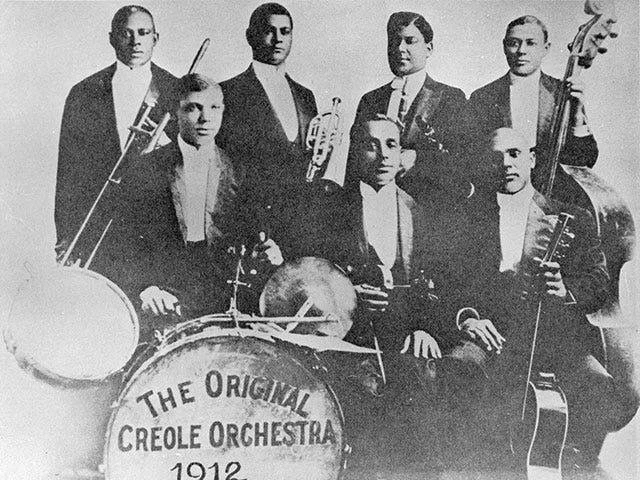
Above: The Original Creole Orchestra photographed in 1912 — two years prior to playing the first jazz show in Winnipeg at Pantages Playhouse Theatre.
Before It Was Called Jazz, Winnipeg Was Already Listening
Before most audiences had a name for it, Winnipeg was already hearing the early sounds of jazz.
According to Winnipeg musician and historian Owen Clark, the city’s first “Jazz” or “Jass” performance took place on Monday, September 21, 1914, at Pantages Playhouse Theatre, when The Original Creole Orchestra performed as part of a vaudeville show.
The group was a six-piece Black ensemble from New Orleans featuring cornetist Freddy Keppard, one of the most important early players of the instrument. In his article “In the Beginning…”, Clark writes that Keppard “preceded Louis Armstrong as one of the New Orleans cornet ‘Kings.’”
“The review in the Winnipeg Tribune the following day stated that the group ‘[played] some weird instruments in a wonderful way.’”
At the time, the performance may not have looked like what audiences now imagine when they think of jazz. Clark notes that the Original Creole Orchestra was a vaudeville act, and that the “Jazz” portion of the show was “apparently limited to one number at the end of their show.”
Still, that one number made an impression.
A review in the Winnipeg Tribune the following day described the group as having “played some weird instruments in a wonderful way” — a brief but vivid response to a sound that was still new, unfamiliar, and hard to categorize.
This was jazz before jazz had fully become “jazz”: lively, rhythmic, theatrical, rooted in New Orleans, and carried north through the touring entertainment circuits that connected cities across North America.
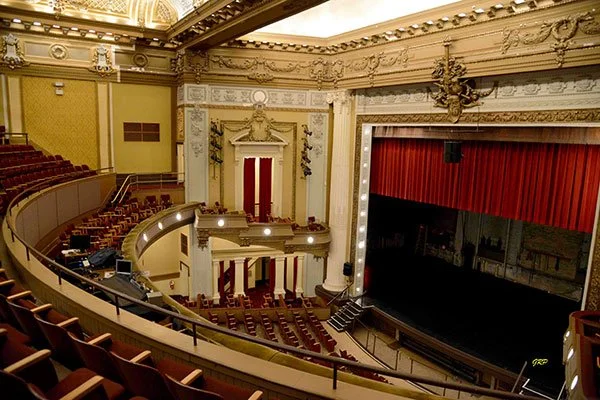
Above: Interior of Playhouse Theatre (September 2018), where Winnipeg’s first jazz performance occured in 1914. Source: George Penner.
A New Sound on the Vaudeville Stage
In 1914, jazz was still becoming itself.
The music had not yet settled into the familiar language of recordings, clubs, festivals, or concert halls. Audiences encountered it through travelling shows, dance bands, theatre programs, minstrel and vaudeville acts, and popular entertainment bills that mixed music, comedy, novelty, dance, and spectacle.
That context matters. Early jazz did not arrive in Winnipeg as formal concert music. It arrived as part of a show.
As Clark writes, performances of this new “Jazz” music were “as much vaudeville show as they were musical performance,” and performers used “any antic to please the audience.”
For audiences, that combination of music and showmanship was part of the excitement. The sounds were unfamiliar, but the setting was not. Pantages was a theatre built for touring entertainment — a place where Winnipeg audiences came to encounter acts from elsewhere, moving through the city as part of a larger circuit.
Long before music could spread instantly through radio, television, recordings, or streaming, it travelled through people: musicians on trains, performers on stages, touring companies moving city to city, and audiences hearing something live for the first time.
The Original Creole Orchestra was part of that movement.
Freddy Keppard and the Sound of New Orleans
At the centre of the Original Creole Orchestra was Freddy Keppard, a New Orleans cornetist whose reputation was already significant before Louis Armstrong became jazz’s most famous early figure.
The cornet played a central role in early jazz. Similar to the trumpet, but often warmer and rounder in tone, it frequently carried the lead melodic voice in New Orleans ensembles. Around it, other instruments could answer, weave, bend, and decorate the melody, creating a sound that felt conversational rather than fixed.
To modern listeners, early New Orleans jazz can sound busy, joyful, and full of motion. Instead of one soloist stepping forward while everyone else stays in the background, several instruments often move together. The result is a kind of collective musical conversation: structured, spontaneous, rhythmic, and alive — and that was part of what made the music feel so different.
Ragtime had already introduced audiences to syncopated rhythms and popular dance forms, but the sound brought by groups like the Original Creole Orchestra pushed that energy further. The music had bounce, surprise, momentum, and a sense of musicians responding to one another in real time.
For Winnipeg audiences in 1914, it may have sounded both familiar and completely new.
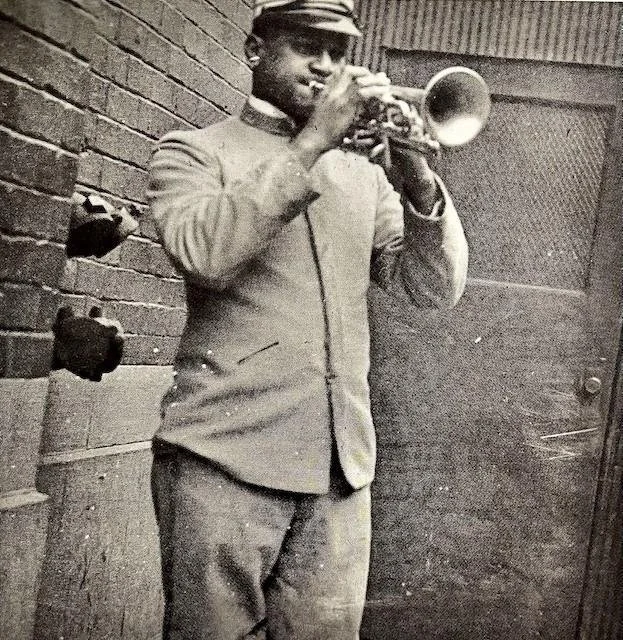
Above: Cornet player Freddy Keppard was a pioneer of early jazz music.
“Freddy preceded Louis Armstrong as one of the New Orleans cornet ‘Kings.’ ”
Winnipeg Musicians Were Listening
The significance of the Original Creole Orchestra’s performance is not only that Winnipeg audiences heard early jazz. It is that local musicians heard it too.
Clark writes that Winnipeg pianist Ab “Albert” Templin was influenced by the “Jazz” performances he attended and went on to form The Original Winnipeg Jazz Babies, a group that toured western Canada by train in 1919.
That detail opens up a larger story. Jazz was not simply arriving in Winnipeg and disappearing when the touring act left town. It was being absorbed, imitated, reworked, and carried forward by local musicians.
The music moved through memory and imitation as much as through sheet music or recordings. A musician heard something on stage, tried to understand it, brought it into their own playing, formed a band, and took that sound somewhere else.
In that sense, Winnipeg was not just a stop on the tour. It became part of the route through which early jazz ideas continued to move.
Not Everyone Was Ready for Jazz
New sounds often meet resistance, and jazz was no exception.
Clark notes that to many musicians trained in concert bands, military bands, or European orchestral traditions, jazz “did nothing to promote serious musicians and their art.”
“At its October, 1920 board meeting, the Winnipeg Musicians Union prohibited its members from playing Jazz.”
That tension says a lot about the period. Early jazz was energetic, rhythmic, improvisational, and closely tied to dance and popular entertainment. To some established musicians, that made it seem less serious, less refined, or even threatening to older ideas of musical respectability.
In October 1920, according to Clark, the Winnipeg Musicians Union prohibited its members from playing Jazz.
The ban was short-lived, but it is revealing. Jazz had made enough of an impact in Winnipeg that musical authorities felt the need to respond to it. The music was not being ignored. It was being debated, resisted, and eventually absorbed into the city’s musical life.
By late 1921 and early 1922, Clark writes, the Allen Theatre was presenting “Jazz Week” performances featuring musicians including pianist Harold Green, Sammy Friedman, and drummer Preston “Press” Purdy. Around the same time, jazz-linked musicians were appearing in dance halls and entertainment venues throughout the city.
The sound had arrived — and despite resistance, it kept moving.
From Touring Acts to Local Dance Halls
The years that followed show how quickly jazz and dance music became part of Winnipeg’s entertainment landscape.
Clark traces a line from the early appearances of touring acts to local ensembles, theatre performances, dance halls, and after-hours jam sessions. The story moves through places like the Orpheum Theatre, the Allen Theatre, the Alhambra Dance Hall, Roseland Dance Gardens, and the Shanghai Tea Gardens in Chinatown.
These venues mattered. They were the spaces where musicians worked, audiences gathered, and new sounds became part of the city’s nightlife.
By the 1920s and 1930s, Winnipeg’s jazz story was no longer only about touring performers passing through. It was about local players, visiting musicians, dance bands, and communities of listeners helping shape a living scene.
Clark’s article points to a remarkable cast of musicians: Ab Templin, Sammy Friedman, Preston “Press” Purdy, Benny Starks, Bill Moore, Art Woodfield, Ollie Wagner, Paul Grosney, and many others. Together, their stories show jazz taking root in the city over time — not in one single moment, but through years of performance, influence, adaptation, and exchange.
Why This Moment Matters
More than a century later, the Original Creole Orchestra’s 1914 performance at Pantages Playhouse gives Winnipeg an early place in the story of jazz in Canada.
At the time, jazz was not yet a polished genre, a festival tradition, or an academic subject. It was still taking shape — drawing from ragtime, blues, dance music, theatre, vaudeville, New Orleans ensemble playing, and the movement of Black musicians across North America.
The audience may not have known they were hearing something that would later be considered historic. They may simply have heard music that felt unfamiliar, exciting, and new.
That is often how musical history works. A touring band comes through town, people listen, local musicians pick up on something, and the music keeps moving. What remains is influence, memory, and the beginning of a local tradition.
In Winnipeg, that early encounter became part of a much longer story. Jazz moved from vaudeville stages into dance halls, clubs, hotels, festivals, and local bands, changing along the way.
You can still hear echoes of that history today. At Jazz Winnipeg’s Jazz at the Fort Garry Hotel in 2026, the 11-member River City Syncopators perform the hot jazz, Charlestons, fox-trots, and popular arrangements of the 1920s. Their music does not recreate the 1914 performance, but it brings listeners close to the sound world that followed it — a period when jazz was spreading quickly, dance music was changing, and Winnipeg was becoming part of a wider North American musical culture.
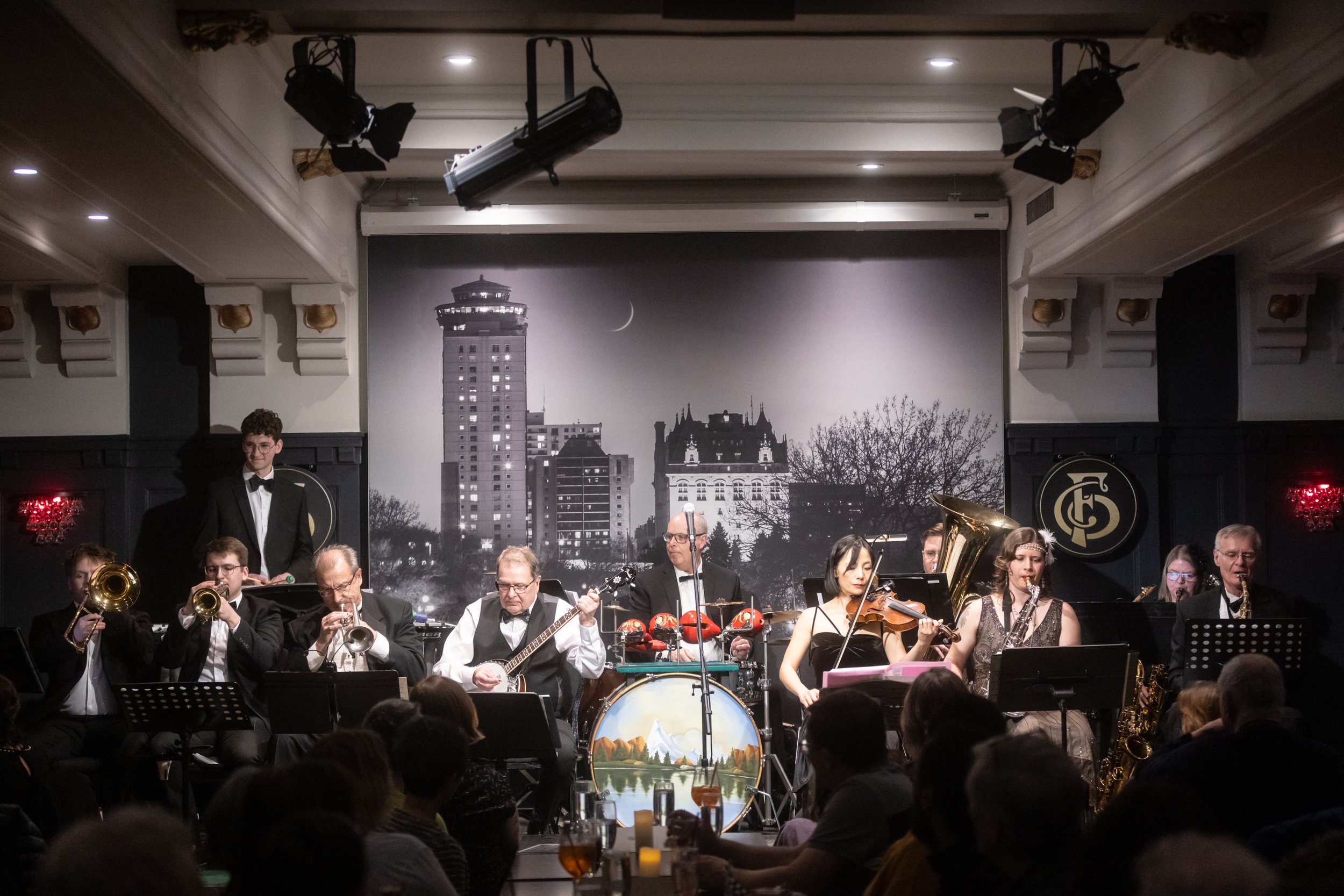
Above: The River City Syncopators perform at Jazz Winnipeg’s Jazz at the Fort Garry Hotel in March 2026, bringing the hot jazz, Charlestons, fox-trots, and dance-band sounds of the 1920s into the present. Photo by Matt Duboff.
That connection between past and present is part of what makes Winnipeg’s jazz history so compelling. The city has been hearing, absorbing, and reshaping this music for more than a century.
In 1914, Winnipeg was already part of the conversation — and today, it still is.
🎶 Help Carry Jazz Forward
This story reminds us that jazz in Winnipeg has deep roots — from early touring musicians and historic venues to the artists, educators, and community members keeping the music alive today. When you support Jazz Winnipeg, you help us honour that history while investing in what comes next: live performances, local artists, youth programs, music discovery, and more opportunities for people to experience jazz in our city. Help us keep the story moving forward.