Calling the Spirit: Niall Cade’s Coltrane Journey
For Winnipeg tenor saxophonist Niall Cade, John Coltrane’s music is not a monument to recreate — it is a spirit to reach for, full of fearlessness, vulnerability, risk, and communion.
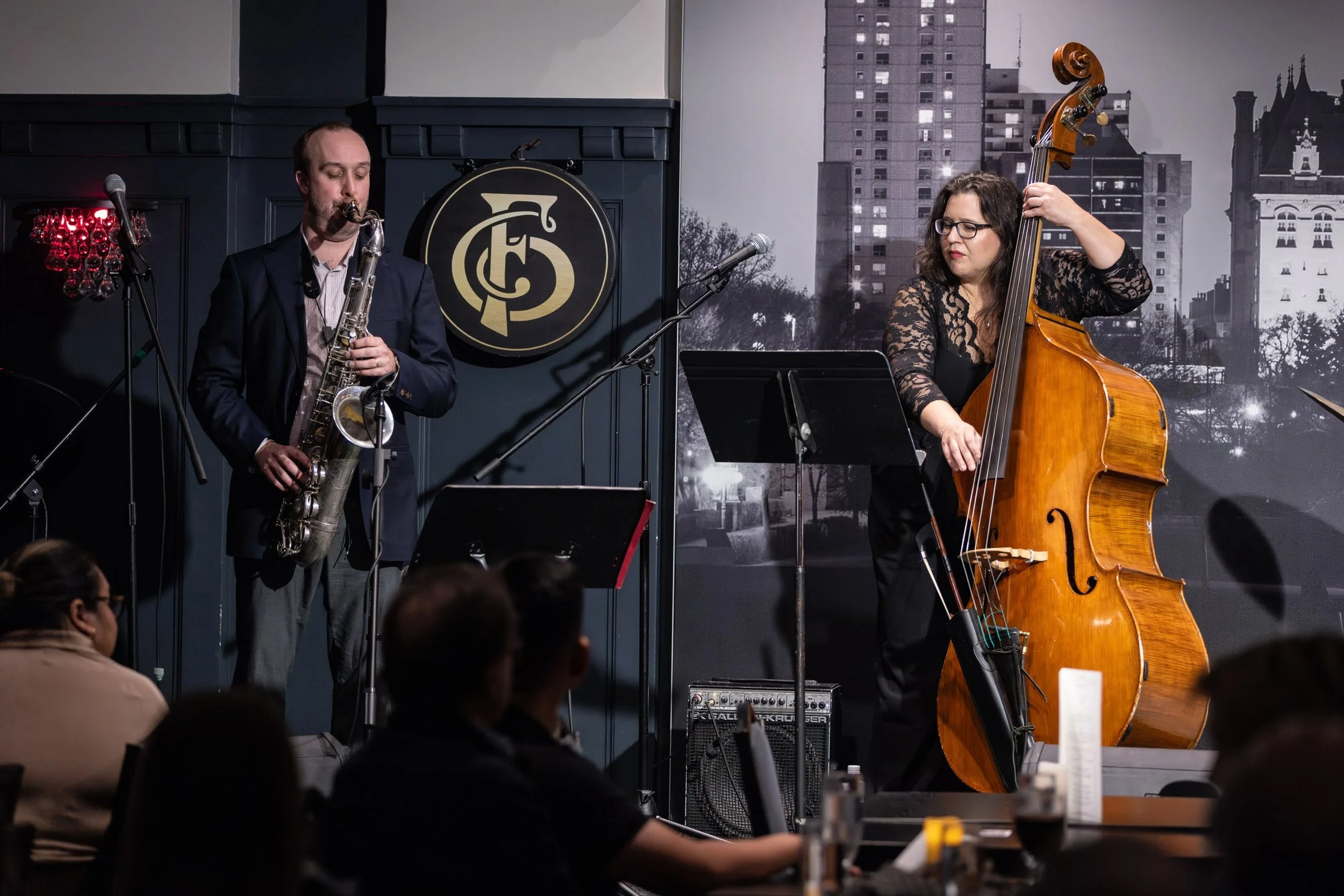
Above: Niall Cade performs with Lindsay Woolgar at Jazz at the Fort Garry Hotel in September 2024. Cade returns to The Club Room on Sept. 20 with Woolgar, Will Bonness, and Kevin Waters for a centennial tribute to John Coltrane. Photo by Matt Duboff.
🎧 Listen Along: Ahead of his John Coltrane centennial tribute at Jazz at the Fort Garry, Niall Cade has curated a playlist of Coltrane recordings that speak to the sound, spirit, and search behind the music. Press play while you read — and hear the energy, risk, and depth that continue to inspire Cade and generations of jazz musicians. Listen to Niall Cade Selects→
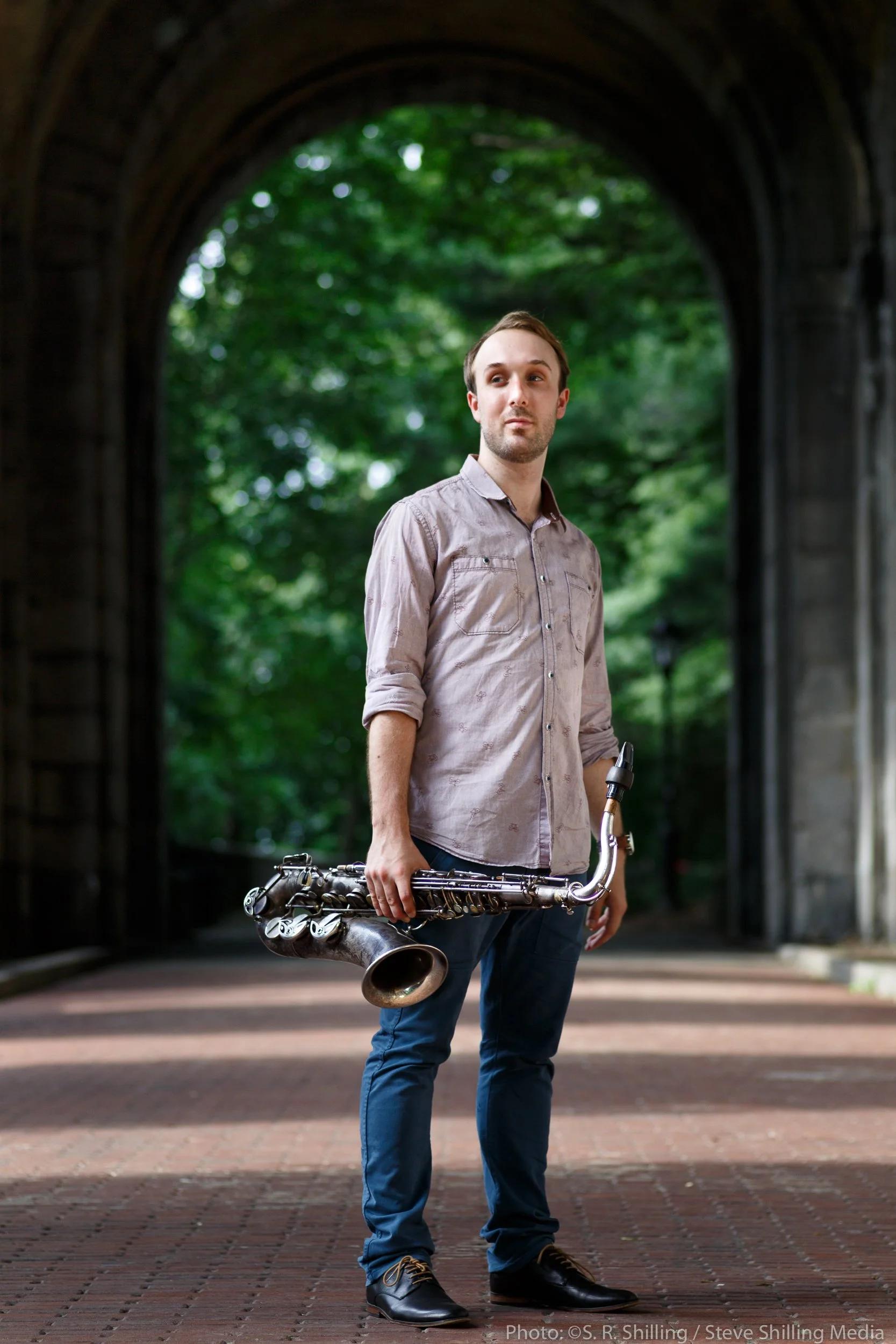
Above: Niall Cade is a Winnipeg-based saxophonist, composer, and educator whose music is shaped by jazz tradition, improvisation, and a deep sense of curiosity. He brings his John Coltrane centennial tribute to The Club Room on September 20. Photo by Steve Shilling.
Niall Cade remembers the sound feeling almost alien.
Growing up in Winnipeg, he first encountered jazz and blues through CDs his father brought home from business trips to places like Chicago and New Orleans. At a time when much of the music around him came from the pop world of the moment, Cade found himself drawn toward something different: the fire of Charlie Parker, the blues, and the searching sound of John Coltrane.
“Someone like John Coltrane or Charlie Parker was just so alien and different,” Cade recalls. “I kind of latched on to that sound and that creativity from a very young age.”
It was music that felt creative, strange, and personal. In another telling, Cade describes it as something that felt “uniquely mine,” especially growing up in Winnipeg — where not many teenagers were checking out Coltrane and Parker at 14 or 15.
But the music did not stay on the CDs.
Around 13 or 14, Cade began finding his way into Winnipeg’s jazz community through jazz camp and live jam sessions. Hearing that level of musicianship up close — the speed, the facility, the freedom, the interaction — made a lasting impression.
“I couldn’t believe the facility, the things that they were playing,” he says. “It just kind of blew my mind at such an impressionable age.”
That early curiosity eventually became a serious path. Cade went on to complete a Bachelor of Jazz at the University of Manitoba and a Master of Music from the Manhattan School of Music, spending time in New York and performing with artists and ensembles including the Philip Harper Quintet, the Quincy Davis Quintet, the Big Jimmy Greene Band, and Bobby Sanabria’s Afro-Cuban Jazz Orchestra.
Today, Cade is a Métis/settler saxophonist, composer, and educator. He teaches jazz musicianship and improvisation at the University of Manitoba, leads the jazz-fusion group Faux Pas Funk, co-leads the Galloway/Cade Big Band, and continues to perform, compose, arrange, and contribute to projects across jazz, pop, R&B, big band, and beyond.
Still, for all the places the music has taken him, the thread running through Cade’s story leads back to the saxophone lineage that first caught his ear: Charlie Parker, Sonny Rollins, John Coltrane, Joe Henderson, Wayne Shorter, Michael Brecker, Chris Potter, Mark Turner, and the many players he says he has “tried to steal something from.”
That line is funny, but it says something true about jazz. The music moves through listening, study, influence, and transformation. Musicians inherit a language, then spend their lives making it their own.
“Coltrane’s playing was visionary, and it was always searching.”
For Cade, Coltrane’s greatness is not only technical. It is spiritual, creative, and restless. Coltrane’s playing, he says, was “visionary” and “always searching” — full of risk-taking, forward motion, and the desire to push the music further.
That is part of what makes approaching Coltrane’s music so meaningful, and so daunting. For a tenor saxophonist, Coltrane is not just another name in the jazz canon. He is one of the towering figures of the instrument: a musician whose sound, discipline, intensity, and imagination continue to shape generations of players.
So Cade is careful about the idea of “playing Coltrane.”
The goal is not imitation. It is not to recreate solos, copy a historical sound, or treat the music like something frozen in time.
“We are going to be trying to bring just a tiny bit of that energy, that fearlessness, and that vulnerability to our performance,” Cade says.
That humility matters. Cade knows there is no simple way to match Coltrane’s technical command or musical force. But the tribute is not about matching him note for note. It is about entering the space Coltrane’s music opens up — a space where risk, discipline, intensity, and openness can meet.
For Cade, that space is where live jazz becomes something more than performance.
He talks about music as communal, even ritual. Something that brings people together, not only to hear songs, but to share a moment of attention, surprise, and possibility. In jazz, especially, that moment is alive because no one knows exactly what will happen next.
“Live jazz is about this group effort to reach beyond each individual to something greater.”
Cade describes improvisation as “walking the tightrope” — a kind of controlled chaos where musicians listen, respond, take risks, and shape the music as it unfolds. The audience becomes part of that experience, too, because what happens in the room happens only once.
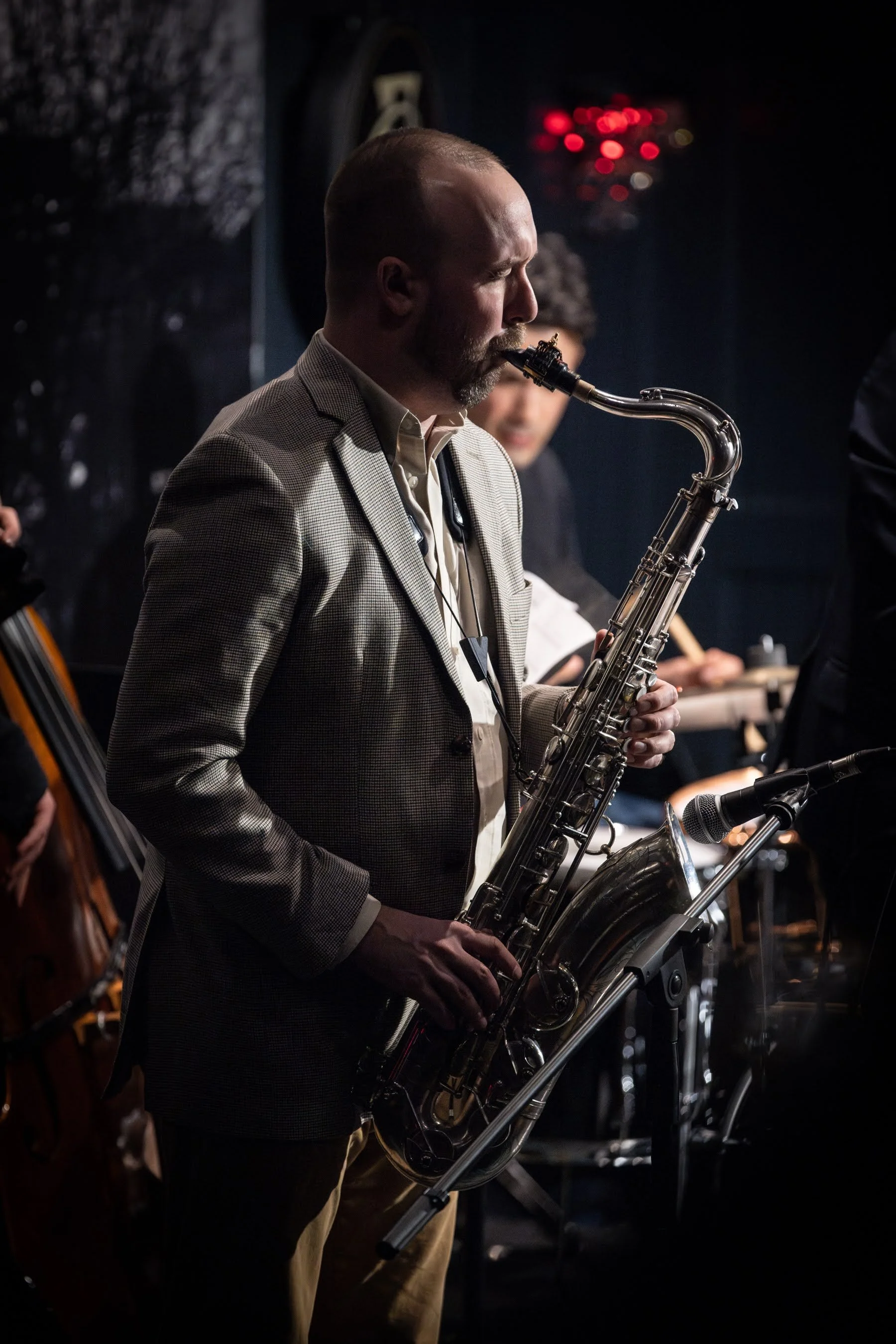
Above: Niall Cade performs with Jon Challoner in The Club Room in October 2024. Cade returns on Sept. 20 for a John Coltrane centennial tribute. Photo by Matt Duboff.
That is part of the power of a small listening room like The Club Room. The details are close. The choices are immediate. The energy moves between the band and the audience in real time.
For this performance, Cade will be joined by Kevin Waters, Lindsay Woolgar, and Will Bonness — a quartet of Winnipeg musicians stepping into Coltrane’s catalogue with reverence and curiosity.
“We’ll be looking to really open the room up,” Cade says. “Just play and let loose.”
That’s what makes the show feel like more than a centennial tribute. Coltrane’s music still has momentum. It still asks something of the musicians playing it — to listen closely, take risks, and stay open to wherever the music wants to go.
For Cade, live jazz feels especially important now, in a time when music is often consumed alone, digitally, and in passing. A concert asks something different of people. It asks them to gather, listen, focus, and be present for something that cannot be paused, skipped, or repeated in quite the same way.
For Cade, live jazz feels especially important now, in a time when music is often consumed alone, digitally, and in passing. A concert asks something different of people. It asks them to gather, listen, focus, and be present for something that cannot be paused, skipped, or repeated in quite the same way.
“Something will be played that you will not have heard before, that you will not hear again.”
That presence is central to what Cade hopes audiences feel.
He hopes the musicians on stage can “reach beyond the technical” and toward “something bigger than ourselves.” Maybe that something is spiritual. Maybe it is communal. Maybe it is simply the feeling of a room full of people giving themselves over to the same moment.
Whatever name we give it, Cade is chasing that feeling.
The sound that first opened jazz up for him as a teenager in Winnipeg has never really left. It has only deepened: through study, community, performance, and the ongoing search for what the music can become in the moment.
Cade is not trying to recreate Coltrane. He is trying to honour what made the music feel alive in the first place: the search, the risk, the openness, and the possibility that something unexpected might happen in the room — and that only happens live.
Keep Live Jazz Alive in the Room
Niall Cade describes live jazz as something that happens once — a moment of risk, listening, and connection that “you will not have heard before” and “will not hear again.”
Your donation helps Jazz Winnipeg create those moments: supporting local artists, presenting live music in intimate spaces, and keeping jazz accessible for audiences in Winnipeg.
When you give, you help make room for musicians to take risks, honour the tradition, and carry the music forward.